The Beginnings of TWC (excerpt from Against Tech Oligarchy)
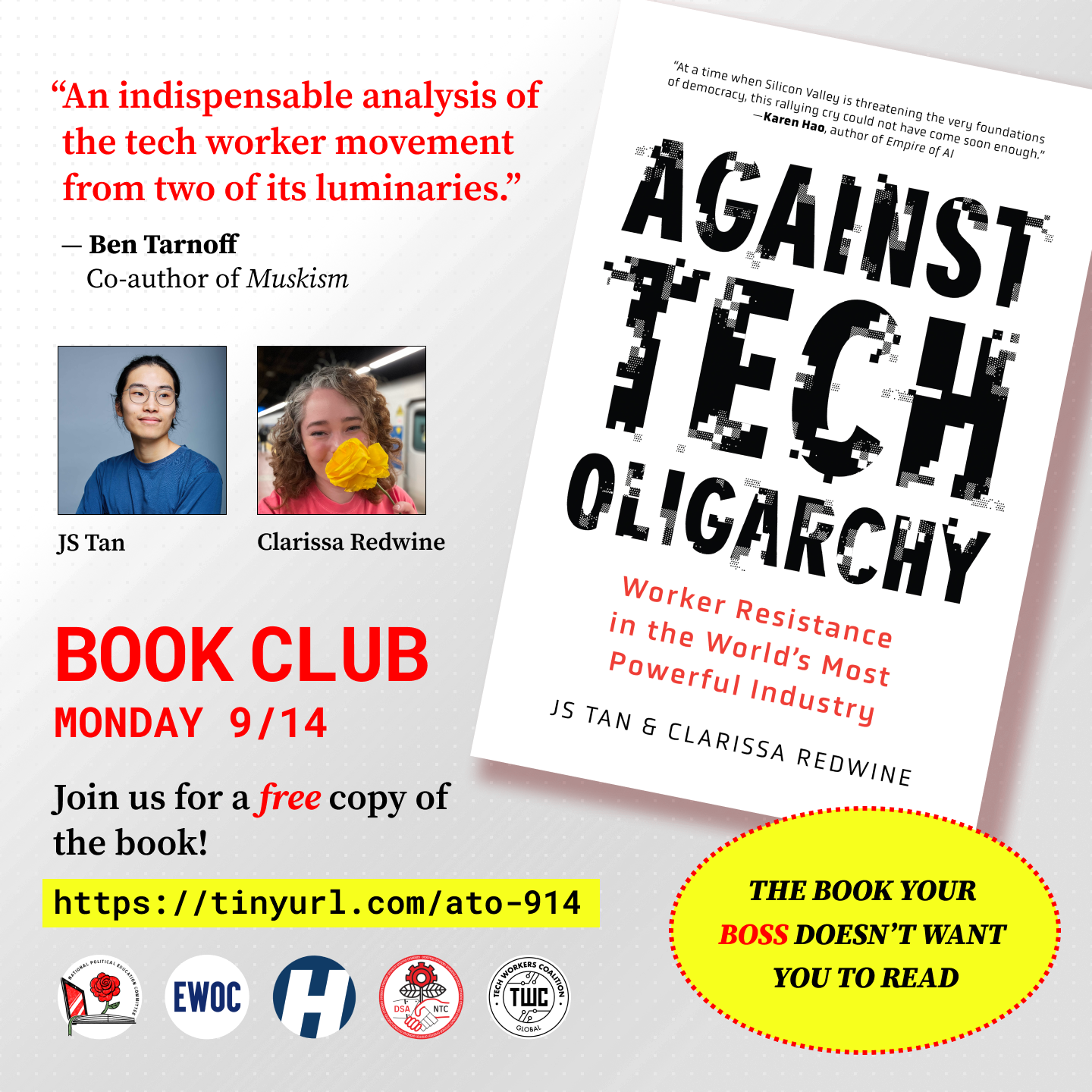
Two longtime tech worker organizers and TWC members, JS Tan and Clarissa Redwine, have just published AGAINST TECH OLIGARCHY, a new book on the history of our movement as tech workers, recounting the rise of tech worker activism, why workers came together to challenge the industry’s most powerful bosses, and how our movement changed Silicon Valley forever. There’s a lot to learn here, and also a lot of strategic argument to debate, and TWC is excited to be co-hosting a virtual reading group with the authors. Join the kickoff session on September 14th to get a hardcover copy of the book for free in your mail. RSVP here. The book is also available for pre-order today.
Below is an excerpt from the book that showcases the Tech Workers Coalition’s critical role in shaping the movement:
It is hard to fit a movement neatly into a box. Where we choose to draw its boundaries, or pinpoint its beginning, is often arbitrary. So far, this story has shown us how tech workers, once convinced of their industry’s prosocial mission, came to feel betrayed as their employers sided with Trump and chased profits through military contracts or Big Oil partnerships. But the rise of tech worker class consciousness was also spurred in no small part by the broader resurgence of the American left.
During the 2016 presidential election, Bernie Sanders’s campaign for the Democratic nomination electrified millions across the country by offering a bold critique of corporate power in the country. For a generation that had come of age amid growing wealth inequality, precarious work, and political disillusionment, Sanders spoke to the frustrations that had long been simmering beneath the surface. His campaign sparked a movement that would continue well past the electoral cycle. Groups like the Democratic Socialists of America saw membership surge dramatically, growing from some six thousand members in 2015 to over fifty thousand by 2018. And although Sanders ultimately lost the Democratic nomination, his candidacy taught many young voters that the political system was fundamentally captured by corporate elites and unlikely to deliver meaningful change.
The left’s renewed energy—and its focus on workplace democracy, collective action, and economic justice—seeped into the zeitgeist of tech’s white-collar workforce just as the contradictions of the industry itself were becoming impossible to ignore. During the election cycle, tech workers were some of Sanders’s most enthusiastic supporters. In terms of employee donations, four of the top five employers contributing to his campaign were major tech firms. Google was number one. Microsoft, Apple, and Amazon were third, fourth, and fifth, respectively. By contrast, Hillary Clinton had not one tech company among her top five and only one within her top twenty. By occupation, tech workers ranked second only to educators among Sanders’s largest donor groups.
During this period, one of the key organizations channeling leftist and socialist ideas into the nascent tech worker uprising was the Tech Workers Coalition. From its start, TWC positioned itself as a direct challenge to the prevailing Californian Ideology. Founded in 2014 by Rachel Melendes and Matt Schaefer, the group emerged from informal conversations the two began having in the mid-2010s about labor, power, and inequality in the tech industry. Their backgrounds couldn’t have been more different: Melendes was a contractor working as a cafeteria employee at a tech firm before becoming a professional organizer with Unite Here, while Schaefer was a software engineer. The starkly contrasting roles that the pair occupied provided a germ for the foundation of the group’s vision. Together, they established two core principles that would define TWC’s politics. First, they adopted an expansive definition of who counted as a “tech worker”—not just coders and designers, but all workers whose labor sustained the tech industry, including cafeteria workers, content moderators, office managers, gig workers, and so on. Second, as a political act, they set out to popularize the term “tech worker.” In the mid-2010s, the term would’ve been considered by most in the industry to be somewhat of an oxymoron: How could someone working in tech possibly be considered a worker? By insisting that even highly paid and technically skilled employees like Schaefer were workers whose interests are in opposition to management’s, the pair sought to embed a class position within the very term that workers in the industry would come to call themselves.
These values were embedded in one of TWC’s earliest initiatives: supporting the unionization of blue-collar workers in tech. As tech scholar Moira Weigel recounted in a Guardian article, several TWC members began, in 2017, organizing in solidarity with cafeteria workers at Facebook who were campaigning to join Unite Here, a union representing service workers. Though these food service employees technically worked for a contractor—Flagship Facility Services—it was clear to TWC that the real power shaping their work lay with Facebook. If the company could be pressured into adopting a neutral stance toward the campaign, it could change the calculus for the cafeteria workers trying to win their union.
So TWC members, some employed as engineers by Facebook, got involved in the organizing effort. They helped reach out to union-eligible cafeteria workers who hadn’t yet been contacted, joined roundtable meetings led by Unite Here organizers, and sat with cafeteria workers who shared gutwrenching stories about 3 a.m. wake-ups, punishing commutes, crowded living conditions, and the strain of surviving in one of the most expensive regions in the country while earning poverty wages. Leveraging their position inside the company, these TWC members even pledged to confront Facebook directly if Flagship Facility Services retaliated against the cafeteria workers.
This small group of TWC members also brought the campaign to their own shop floor. They passed out bilingual flyers, put union stickers on their laptops to signal support, and posed pointed questions about workers’ rights during company allhands meetings. Some even got Unite Here organizers guest passes into Facebook’s main campus. It was slow, relational work that required learning new skills, especially for some tech workers who had never broached the subject of working conditions with their coworkers and had to overcome the feeling of transgressing an unspoken norm—but they understood the significance of this new approach. By spring 2017, TWC members were camped out at a Starbucks near one of Facebook’s largest cafeterias, helping cafeteria workers sign union cards after their shifts. The campaign picked up speed, and by June, five hundred workers had joined. One month later, the cafeteria, with the help of TWC, won their union. … As TWC matured as an organization, its membership discovered and started educating themselves on previous cases of radical activism in the industry. In the late 1960s, the Computer People for Peace, an organization led by computer scientist and activist Joan Greenbaum, had mobilized computer workers against the Vietnam War and corporate complicity in military and surveillance systems. In 1971, Caroline Hunter and workers at Polaroid organized a boycott attempting to stop the company from supporting ID systems in apartheid South Africa. A decade later, Computer Professionals for Social Responsibility, founded in 1981 by computer scientists such as Lucy Suchman, became strong advocates for the ethical and democratic use of technology. These predecessors offered both inspiration to the newly formed TWC and reminded them that the idea of a politically engaged tech workforce had deep historical roots.
Drawing on this radical history, TWC grew into a political home for a rising wave of tech workers already eager to confront the industry’s power. As Kristen Sheets, a member of TWC’s founding group, pointed out in an interview, the organization’s goal was to “build infrastructure and organization around that energy,” adding, “if we actually want a tech workers union, it’s going to be a long fight. We’re going to need to be extremely organized and have a lot of people on our side to win.” With this ambition in mind, the group, beginning in the Bay Area, soon expanded into chapters across New York, Seattle, Boston, Washington, DC, and even internationally in Berlin and Bangalore. In each city, TWC held regular meetups that blended political education with community-building.
These sessions were crucial testing grounds for workers learning to organize. Many chapters partnered with the Industrial Workers of the World, a radical union that long rejected the business unionism of the mid-century, to offer trainings to tech workers who were virtually all new to organizing. With its national reach and focus on labor and solidarity, TWC became a landing place for Sanders-aligned tech workers eager to channel their political energy into building worker power where they held the most leverage.
As more people from around the country joined, TWC evolved into a sprawling, decentralized network—and at the center of that network was a burgeoning community on the Slack messaging platform. Welcoming thousands of tech workers from across the industry, the TWC Slack became a kind of virtual commons where workers shared news articles on tech and labor, dissected the latest controversies in the industry, debated tech’s role in capitalism, and even passed around Marxist reading recommendations.
In this way, the TWC Slack was a third space for an extremely distributed workforce who would otherwise not have had many places to meet each other and swap learnings. And as the number of TWC members hit a critical mass, Slack became an essential platform for coordination and connection. Sometimes, workers already organizing at their companies even used it to share strategies and build solidarity across firms; other times, this space served as a starting point for organizing, a place where isolated employees could find like-minded colleagues at their company and begin planning campaigns of their own.
JS—who was organizing at Microsoft at the time—remembers how vital this space was. Microsoft was such a vast and compartmentalized company that there were few internal channels for workers to connect over political topics. On TWC’s Slack, however, he encountered other agitated coworkers for the first time—people who shared his frustrations and whom he could help fold into the existing organizing committee at the company.
As more and more tech workers took to activism within their own companies through 2018, TWC became a crucial, if subtle, influence in shaping the consciousness of organizers at Google, Amazon, Facebook, Microsoft, and beyond. Many of the workers involved in these early public pressure campaigns were in fact TWC members. And through this distributed network, TWC quietly seeded its two foundational principles across an increasingly radicalized workforce—first, that the definition of a “tech worker” needed to encompass everyone working in the industry, from cafeteria workers to software engineers; second, that tech workers, even with their comfortable salaries and perks, were considered workers with interests fundamentally different from their bosses.
For both of us, these ideas were transformative. We became true believers in this radical and solidaristic definition of a “tech worker,” convinced that the movement’s power depended on bridging the vast divides within the industry’s workforce. When JS started to archive the surge of tech worker activism in 2018 under the name Collective Action in Tech, he committed to documenting the struggle of Uber drivers, Amazon warehouse workers, content moderators, and other less privileged workers alongside those of the white-collar workforce he was a part of. What was clear to us then was that if engineers and designers failed to join in a common struggle with the cafeteria staff who fed them, or the content moderators who kept the internet clean, then any challenge to tech capital would remain partial and fragile.
More importantly, these ideas offered a powerful alternative to the waning legitimacy of the Californian Ideology, which had long convinced those working in the industry that their work was a force for progressivism and a privileged calling. By this time, however, the countless campaigns that appealed to the better angels of tech leadership, only to be ignored or dismissed, had eroded faith in the idea that the tech industry could be reformed by moral suasion. By the time TWC emerged, many were ready for a different story—one that reframed tech work as embedded within broader systems of power, inequality, and exploitation. With the help of TWC, more and more tech workers no longer saw themselves as above the fray of the centuries-old battle between capital and labor.
If you enjoy this sample of Against Tech Oligarchy, we highly encourage you to join our reading group and/or preorder. And importantly, please also share this book with your co-workers who may stand to benefit the most from reading this book and learning about the brave activism from tech workers all over the country over the past decade.
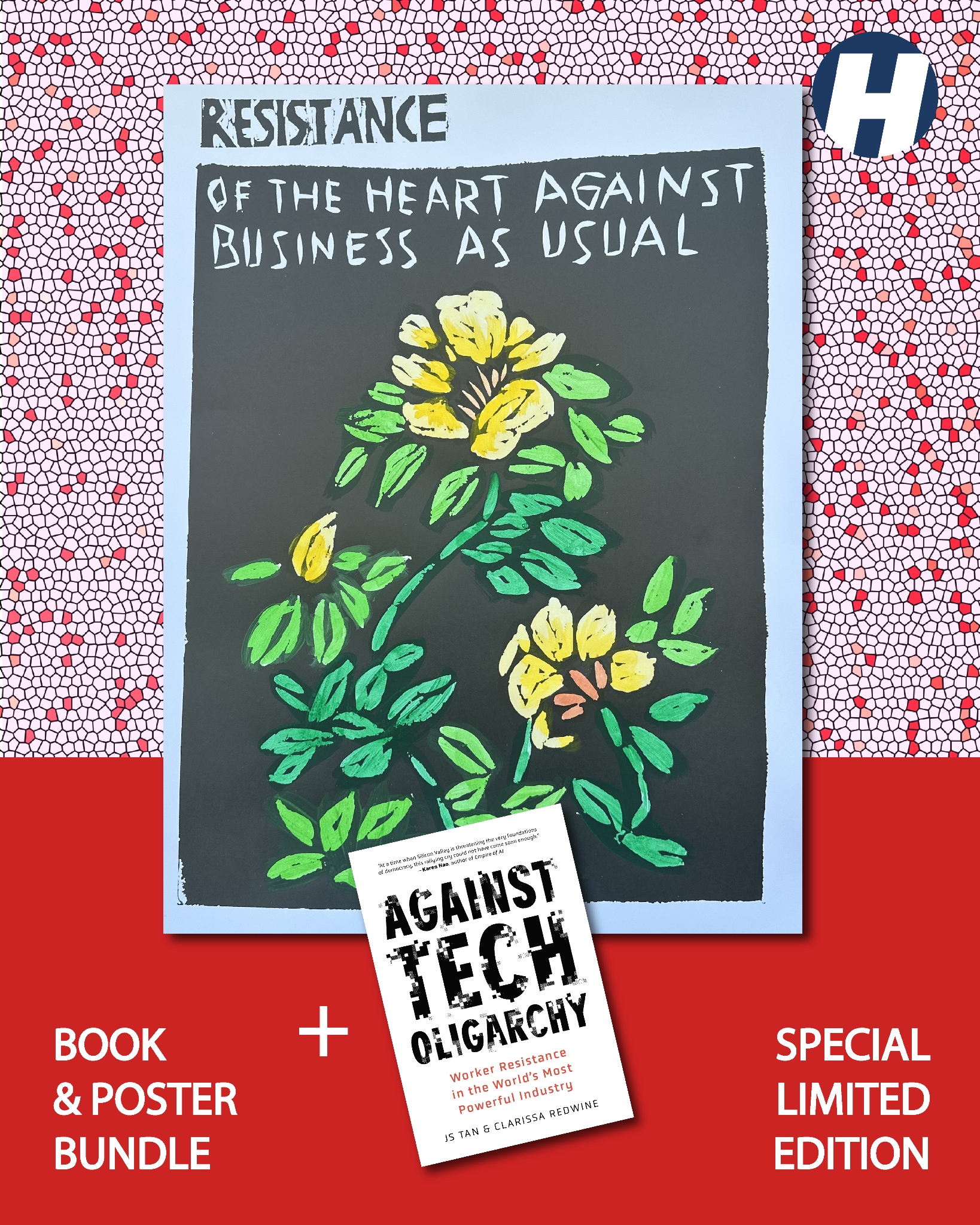
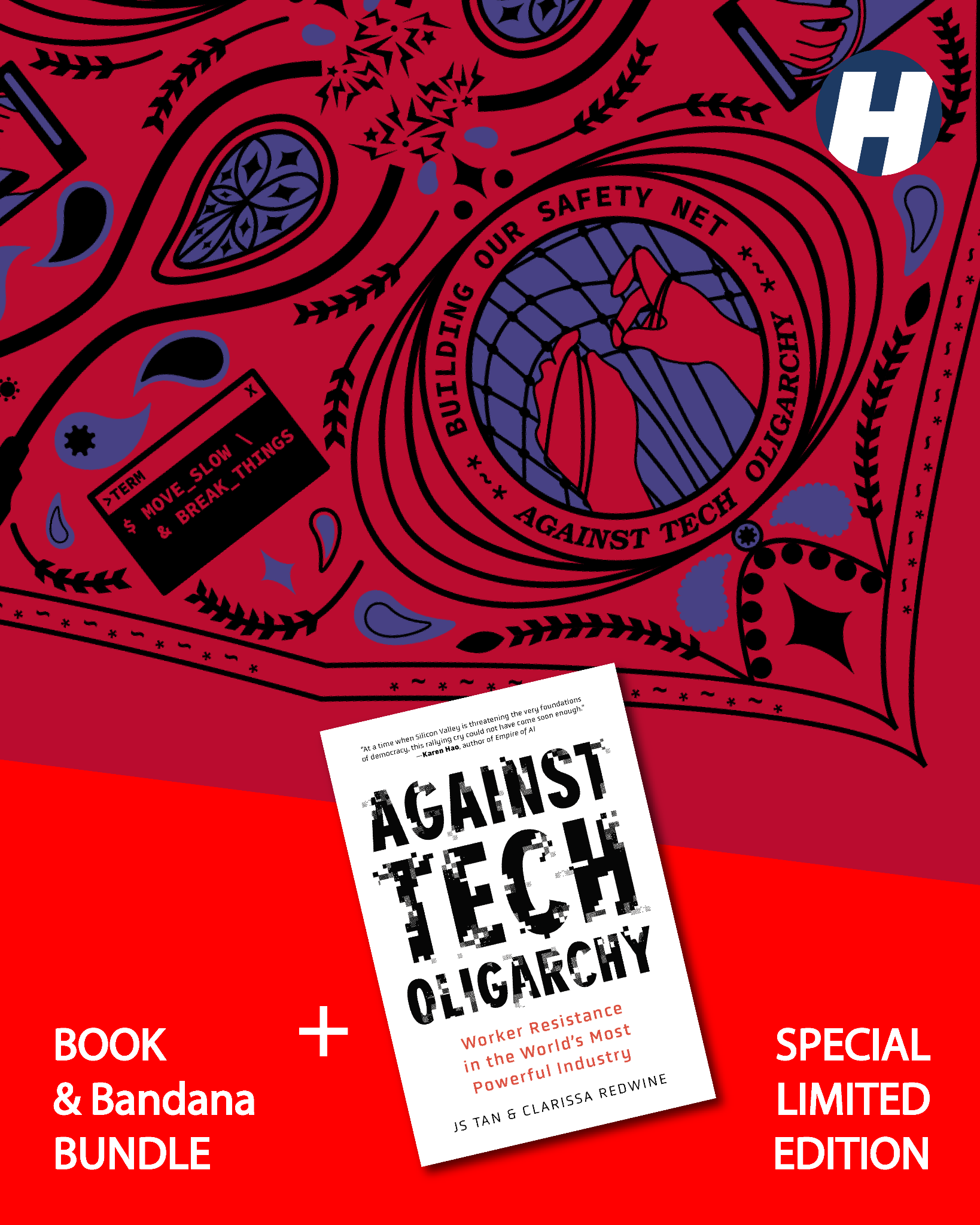
To celebrate the launch of this book, the authors have also teamed up with artists and creators to offer limited edition items. Each piece tells a story of solidarity and worker power. ❤️🔥You can bundle a preorder of the book with any merch until 9/15. Nab a Luddite cap, Bread & Puppet poster, or bandana!